
What Is Form 7004 for Estates?
When a person passes away, their assets (everything they owned or had rights to including cash, investments, real estate, life insurance, etc.), belong to an entity known as an estate. If those assets earn any type of income, it belongs to the estate and must be taxed.
When an estate receives more than $600 of gross income in a year, it generally must report that income on Form 1041. The estate might also need to make quarterly estimated tax payments if it expects to owe tax.
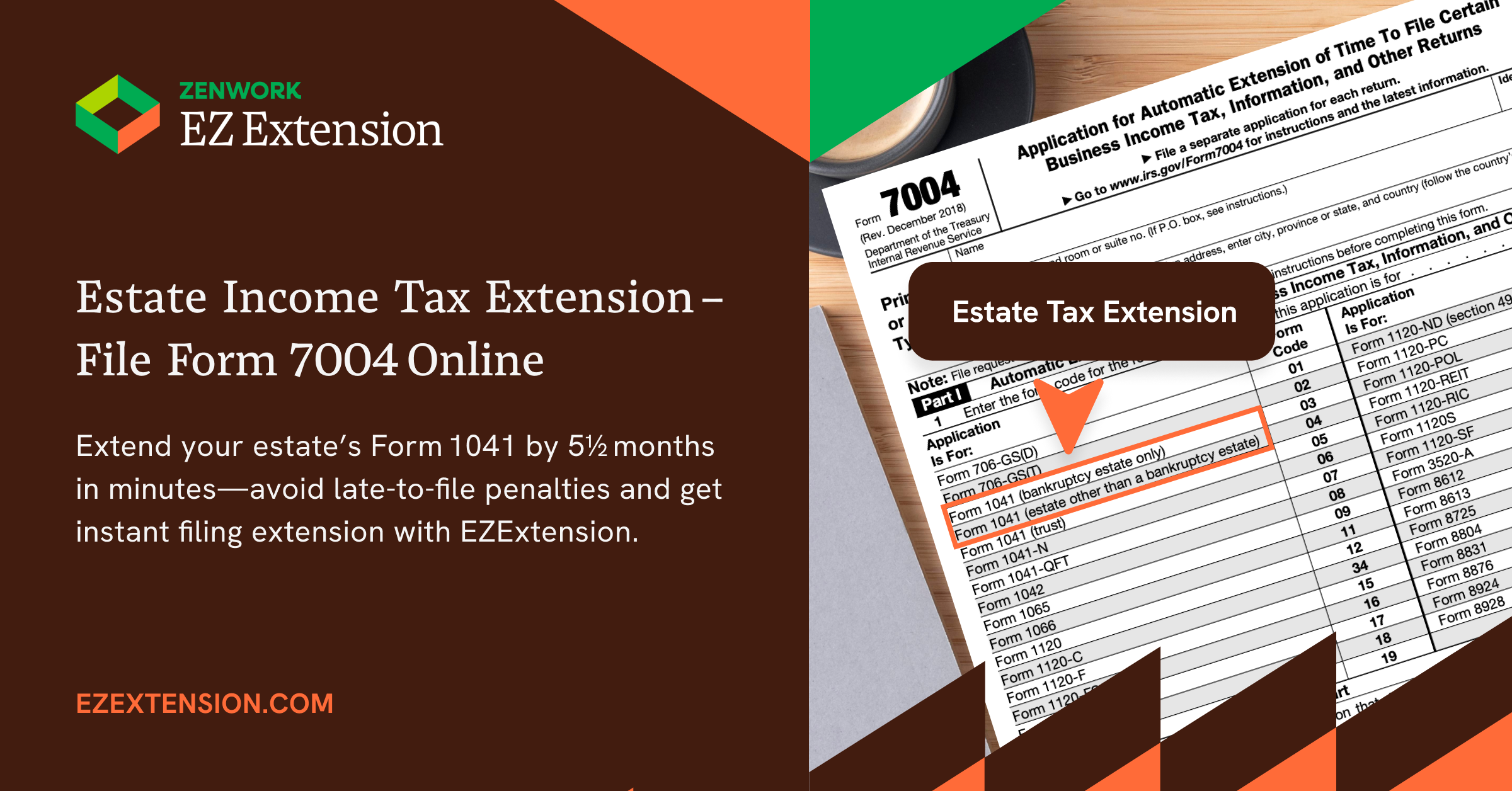
Estates can request extra time for filing Form 1041 by submitting estate Form 7004.This estate income tax return extension provides an automatic 5-month extension for the executor (an individual or entity responsible for administering the estate) to file Form 1041.
Deadlines & Penalties for Estates Filing for a 7004 Extension
The estate income tax return extension due date depends on whether the estate uses a calendar year or a fiscal year.
| Type of Year Used by the Estate (for tax reporting purposes) | Original Form 1041 Deadline | Extended Deadline After Filing Form 7004 |
|---|---|---|
| Calendar Year Estates | April 15 | September 15 |
| Fiscal Year Estates | 15th day of the fourth month after year end | 5 months |
Late-filing penalties for Estates
If you file Form 1041 late, the failure-to-file penalty is generally 5% of the unpaid tax for each month or part of a month the return is late, up to 25%. If no tax is due, that penalty is generally zero. If no tax is due, the failure-to-file penalty is zero. For returns that are more than 60 days late, a minimum penalty may apply: the smaller of $525 or 100% of the tax due.
If the failure to file is fraudulent, the penalty can be 15% per month, up to a maximum of 75%. You can cite reasonable cause to reduce penalties for late estate 1041, but documentation is essential.
Note: If you owe tax and don’t pay it by the original due date, the IRS charges interest from that date until it’s paid, even if you applied for a filing extension.
Executor Checklist Before Filing Form 7004
Before submitting estate form 7004, executors should keep the following list in mind.
- Estates need their own EIN. Get an EIN by applying online or by filing Form SS-4.
- Choose either a calendar year or a fiscal year for the estate.
- Pay any tentative estate income tax due through EFTPS or EFW when e-filing the extension.
- Include Form 1041-V if you are mailing a check with the Form 1041 return.
Line-by-Line Guide to Filing Form 7004 For Estates
- Estate Details: Enter the name of the estate, EIN, and address.
- Part I- Line 1: Use Code 04 if you are requesting an extension for Form 1041 for an estate other than a bankruptcy estate. Use Code 03 only for a bankruptcy estate.
- Part II, Lines 2–4: This section generally does not apply to most estate Form 1041 extension filings.
- Part III, Lines 5a and 5b: Enter the tax year for which you are filing (calendar year or fiscal year).
- Part III- Lines 6, 7, & 8: These lines report the estimated tax owed, aggregated total payments, and the balance due for the year.
Estate Income Tax Pyment Options
Filing Form 7004 does not extend the time to pay estate income tax. You must still pay your tentative tax by April 15 for calendar-year estates, or by the 15th day of the fourth month after year-end for fiscal-year estates, using one of these methods:
- EFTPS (Electronic Federal Tax Payment System): Enroll on EFTPS and pay or schedule a payment.
- EFW (Electronic Funds Withdrawal): Authorize a direct debit during the e‑filing process.
- Direct Pay:Needs verification for this filing/payment type. If kept, confirm eligibility for Form 1041 estate payments before publishing.
- Cash: Pay at IRS-approved retail partners or IRS offices.
- Check or money order: Mail check with Form 7004 to the “United States Treasury”.
- Digital wallet/Credit card*: Pay via an IRS approved third-party payment processor.
State Filing Rules for Estate Filing Extensions
State rules vary. Some states require fiduciary income tax filings for estates and trusts, and some states also impose a separate estate tax.
Each state has its own rules for reporting estate income. Some states may honor the federal extension automatically, while others require a separate state extension form. Confirm each state’s current rules before filing. However, there are a few states that require their own estate income tax return extension.
| State | State Extension Form for Estates | Months Extended |
|---|---|---|
| District of Columbia (DC) | D-77 | 6-month extension |
| Connecticut | CT-706/709 EXT | 9-month extension + 6-month to pay |
| Hawaii | M-68 | 6-month extension |
| Illinois | 700-EXT | 6-month extension |
| Maryland | MET-1E | Up to 6 months; 1 year if filer is out of the country |
| Massachusetts | M-4768 | Automatic 6-month extension if 80% of tax is paid by the deadline |
| New York | ET-133 | Up to 6 months (can also request extra time to pay) |
| Oregon | OR-706-EXT | Automatic 6-month extension |
| Rhode Island | RI-4768 | 6-month extension |
| Vermont | EST-195 | Automatic 6-month extension |
| Washington | REV 85-0048 | 6-month extension |
How to E-File Form 7004 with EZ Extension
Learn how to file an estate income tax extension online in 3 simple steps with EZExtension.
Section 1
In the first section, enter the details of the estate including name, EIN, address, and select Code 04 on Line 1 (or let EZ Extension auto-select the correct form code).
Section 2
Use the in-built AI scan to check the tax form code and EIN. Also, estimate and pay any tentative tax.
Section 3
Review your entries, submit them to the IRS with EZExtension, and get a downloadable PDF receipt.
Why EZExtension
By using EZ Extension, you can get an automatic 5-month extension to file your estate income tax return.
- Quick 3-minute filing process: Simple guided 3 step filing process.
- Phone Support + Online Filing: Offers guided support and online Form 7004 filing.
- Real-time status updates: Get a confirmation via email when you e-File with us.
- Smart AI-powered error detection: AI-assisted error detection before you submit the form.
- Affordable pricing at $9.99: File for an automatic 5-month extension online.
- Secure SOC 2-compliant data handling: Your data is safe with bank-grade encryption and transmitted securely to the IRS.
- Integrated payment options: Securely pay balance due via our integrated payment system.
FAQs
1. How long is an estate income tax extension?
An estate income tax extension gives you an automatic 5-month extension to file.
2. Does Form 7004 cover Form 706?
No, Form 7004 covers only extension for estate income tax return, Form 1041. Form 706 is for estate tax and requires Form 4768 to file an extension.
3. Can I choose a fiscal year for the estate?
Yes, you can choose a fiscal year for the estate.
4. Does the extension delay tax payment?
No, filing an extension for estate income tax return filing does NOT delay tax payments. You’d still need to pay taxes on time.
5. What if I miss the 7004 deadline?
If you miss the Form 7004 deadline for a calendar-year estate (April 15) or a fiscal-year estate (the 15th day of the fourth month after year-end), you may face late-filing penalties of 5% per month, up to 25% of the unpaid tax.
6. Will states accept my federal extension?
Some states grant extensions automatically if payment criteria are met (e.g., Massachusetts). While other states require a separate state form (e.g., New York). Always check state rule for confirmation.
Don’t rush your estate income tax return.
File Form 7004 and get an automatic 5-month extension with EZ Extension.