
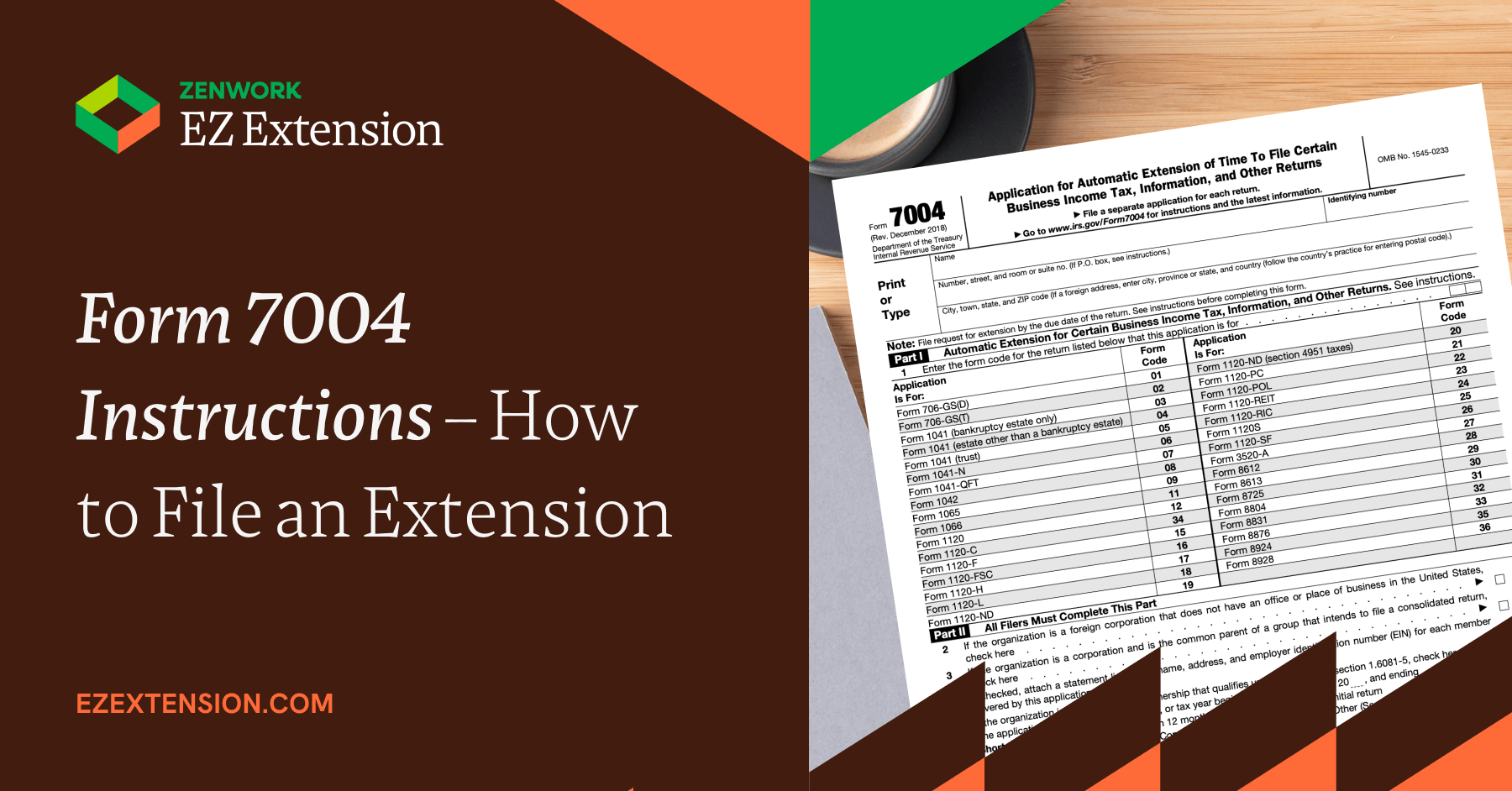
Form 7004 Explained
Anytime you need an extension to file certain business income tax, information, and other similar returns such as forms 1120, 1065, 8924, 1041, 990-C, etc., you fill in Form 7004 and send it to the IRS. This gives you an automatic extension of time to file if Form 7004 is completed properly, filed by the due date, and any tax due is paid.
However, this form is only for requesting an extension to file certain business income tax returns, not for paying taxes. You still need to pay any tax due by the original due date.
Form 7004 applies to many business income tax, information, and other returns, including Forms 1120, 1120-S, 1065, 1041, and others listed on the IRS form.
Mark Your Calendars: Due Date to File Form 7004
IRS Form 7004 instructions require the form to be filed on or before the original due date of the return for which you are requesting an extension.
| Tax Form(s) & Entity Type | Original Due Date | Extended Deadline |
|---|---|---|
| Form 1120-S (S-Corporations) | 15th day of the 3rd month after the end of the tax year | September 15 |
| Form 1120 (C-Corporations) | 15th day of the 4th month after the end of the tax year | October 15 |
| Form 1065 (Partnerships & LLCs) | 15th day of the 3rd month after the end of the tax year | September 15 |
| Form 1041, 1041-N, 1041-QFT (Estates and Trusts) | 15th day of the 4th month after the end of the tax year | October 15 |
| Form 990 and 990-T (Tax-Exempt Orgs) | May 15 | November 15 |
| Other Forms | Varies | Varies |
For more specific dates and fiscal-year rules, check [Form 7004 deadline rules by entity]
Entities That Must File Form 7004
As per IRS Form 7004 instructions, the following filers may be eligible for an automatic filing extension, generally 6 months, with some exceptions.
- S-corporations: Company’s profits or even losses “pass through” directly to the shareholders. As per S-Corp extension Form 7004 instructions, this type of entity needs to file Form 1120-S.
- C corporations are treated as separate legal entities, so the business itself pays tax on its profits. They need to file Form 1120.
- Partnerships: Entities where two or more persons have a business together where profits and losses are shared and then reported on their individual tax returns.
- Multi-member LLCs: A business owned by two or more people where the profits and losses “pass through” directly to the owners.
- Estates & Trusts: An estate manages and distributes the assets of someone who has passed away.
Step-by-Step Instructions: How to Fill Form 7004 (Line-by-Line)
Part 1: Form Code
Line 1: Use the form code for the tax form/return you’re requesting an extension for.
| Tax Form | Purpose | Form Code |
|---|---|---|
| Form 706-GS(D) | Reports trust distributions subject to Generation-Skipping Transfer (GST) tax | 01 |
| Form 706-GS(T) | Reports calculated GST tax & tax due on certain trust terminations | 02 |
| Form 1041 (bankruptcy estate only) | Reports income and deductions for bankruptcy estates | 03 |
| Form 1041 (estate other than a bankruptcy estate) | Reports income & deductions for estates other than bankruptcy estates | 04 |
| Form 1041 (trust) | Reports income, deductions, & distributions for trusts | 05 |
| Form 1041-N | Reports state fiduciary income tax return for estates and trusts in Nebraska | 06 |
| Form 1041-QFT | Reports income for qualified funeral trusts | 07 |
| Form 1042 | Reports withholding of tax on U.S. source income paid to foreign persons | 08 |
| Form 1065 | Reports income, deductions, gains, & losses of partnerships | 09 |
| Form 1066 | Reports income & deductions of REMICs | 11 |
| Form 1120 | Reports income, gains, losses, & tax liability for C-corps | 12 |
| Form 1120-C | Reports income & expenses for cooperative associations | 34 |
| Form 1120-F | Reports U.S. income & tax liability for foreign corporations | 15 |
| Form 1120-FSC | Reports income & tax information for foreign sales corporations | 16 |
| Form 1120-H | Reports income & expenses for homeowner’s associations | 17 |
| Form 1120-L | Reports income & deductions for life insurance companies | 18 |
| Form 1120-ND | Reports income & deductions for nuclear decommissioning funds | 19 |
| Form 1120-ND (section 4951 taxes) | Reports excise taxes on nuclear decommissioning funds | 20 |
| Form 1120-PC | Reports income & deductions for property & casualty insurance companies | 21 |
| Form 1120-POL | Reports income & deductions for certain political organizations | 22 |
| Form 1120-REIT | Reports income & expenses for REITs | 23 |
| Form 1120-RIC | Reports income & expenses for regulated investment companies | 24 |
| Form 1120-S | Reports income, deductions, & tax information for S-corps | 25 |
| Form 1120-SF | Reports income & expenses for settlement funds | 26 |
| Form 3520-A | Annual information return for foreign trusts with U.S. owners | 27 |
| Form 8612 | Reports excise tax on undistributed income of regulated investment companies | 28 |
| Form 8613 | Annual return for low-income housing credit agencies | 29 |
| Form 8725 | Reports excise tax on undistributed income of REIT | 30 |
| Form 8804 | Reports partnership withholding tax for foreign partners’ income | 31 |
| Form 8831 | Reports trust fund recovery penalty | 32 |
| Form 8876 | Certifies reduced reporting for REIT elections | 33 |
| Form 8924 | Claims credit for small employer pension plan startup costs | 35 |
| Form 8928 | Reports certain excise taxes under IRC chapters 41 & 42 | 36 |
Tip: Always double-check the tax form code. Using the wrong code can cause rejection.
Part 2: Details
Line 2: Check this if you’re a foreign corporation without an office or place of business in the U.S.
Line 3: Check this if you are the only common parent or agent of a consolidated return.
Line 4: For entities that pay taxes under Regulations section 1.6081-5 such as:
- Partnerships keeping records outside the U.S.
- Foreign corps with a U.S. office
- Domestic corps keeping books outside the U.S.
- Domestic corps with income from U.S. possessions.
Line 5a: Fill this in if your business doesn’t follow a calendar year.
Line 5b: Check the reason for the shortened tax year (less than 12 months).
Line 6: Enter estimated tax owed or how much you expect to owe for the year.
Line 7: Enter the aggregated total payments, such as estimated payments or refundable credits.
Line 8: Balance Due Enter the total after subtracting the amount in Line 7 from Line 6.
Signature & Authorization
IRS Form 7004 instructions state that no signature is required on this form.
IRS Form 7004 filing instructions require a signature for paper filing and a digital authorization if you’re e-filing.
For paper filing, the signature must be signed by an authorized officer, partner, fiduciary, or other authorized entity representative.
If you are e-filing, follow your provider’s submission steps. IRS Form 7004 itself does not require a signature.
Tip: Make sure the signer’s title is correct and that they have the authority to sign tax documents on behalf of the entity.
Common Errors to Avoid When Filing Line By Line
Using the wrong tax form code in Part I of IRS Form 7004.
EIN and Name combination not matching the data available in IRS records.
Calculating the amount to be reported in cents instead of rounding it up to a whole dollar.
Using incorrect tax year dates on the form for fiscal-year filers.
Not checking the spacing, punctuation, and abbreviations.
How and Where to File IRS Form 7004 (E-File vs Mail)
E-Filing Form 7004
The IRS allows Form 7004 to be e-filed for most returns, and e-filing is often faster and easier than paper filing. This process has a faster processing time, more user-friendly, less hassle, and is generally more accurate.
Mailing to the IRS (paper-filing)
The IRS also accepts paper filing of Form 7004. This is a manual process that requires you to download or print Form 7004, complete it, and mail it to the correct IRS address, fill in form 7004, and send it to the correct mailing address which will be based on the type of tax return you are requesting an extension for, state, and total asset value.
90%+ of businesses now e-file!
Don’t get left behind. Spend less time and money on requesting automatic filing extensions.
Why You Need To Pay Taxes Before Filing Form 7004
IRS Form 7004 filing instructions is only used to request an extension to file certain business returns, not for extending the timeline to pay your taxes.
As per Form 7004 payment instructions, you need to make tax payments using either EFTPS, EFW (direct debit), or even a same-day wire transfer. The payment must be made by the original due date.
If you do not pay tax by the original due date, the failure-to-pay penalty is generally 0.5% of the unpaid tax for each month or part of a month, up to 25%. You may also need to pay an interest charge on unpaid taxes every month until the tax is paid.
FAQs
1. How long does IRS Form 7004 extend my return?
Form 7004 gives you an automatic extension to file certain business tax returns, generally 6 months depending on the return.
2. Does Form 7004 extend the time to pay taxes?
No, Form 7004 only extends the deadline to file the return, it does not extend the time to pay taxes. Any taxes owed must still be paid by the original due date.
3. What business tax forms can I extend with Form 7004?
You can use Form 7004 to extend the filing deadline for a variety of forms including 1120 for C-corporations, 1120-S for S-corporations, 1065 for partnerships, and other business return forms.
4. Can I file Form 7004 after the deadline?
No, you can only file Form 7004 on or before the original due date of the return you’re filing an extension for.
5. How do I choose the correct IRS code on Form 7004?
The IRS code on Form 7004 should always correspond to the return you’re filing an extension for. For example, if you are filing an extension for Form 1120-C, you’ll need to use Tax Form Code 34.
6. What is the penalty if I forget to file Form 7004?
If you did not file an extension form and your return is not filed by the original due date, you’ll need to pay failure-to-file penalties.
7. Can I e-file Form 7004 for multiple businesses?
Yes, if you are authorized to represent multiple entities, you can e-file separate Form 7004 extensions for each business.
8. How do I know if the IRS accepted my Form 7004?
The IRS no longer sends a notice that your extension has been approved; it will notify you only if your request is disallowed. Once you file the extension, you will automatically get a 6-month filing extension. The IRS will generally contact you only if the extension request is disallowed or there is an issue with the filing.
9. What happens if my Form 7004 is rejected?
If your 7004 was rejected, you can correct and resubmit before the original due date to avoid late filing penalties.
10. Do all states honor IRS Form 7004 for state extensions?
State extension rules vary from one state to another. There are some states that accepts Form 7004 while others need separate state extension forms. Make sure to check your state’s extension rules separately, because they may differ from the federal Form 7004 rules.
11. Can I amend Form 7004 after submission?
If a Form 7004 filing has an issue, correction options depend on timing and filing method.
12. Is EZExtension IRS-authorized to file Form 7004?
Yes, EZExtension is an IRS authorized e-file provider that lets you file a 6-month automatic extension within minutes.
Give yourself more time. File IRS Form 7004 in minutes, extend your deadline by 6 months, and stay stress-free. Only for $9.99.